
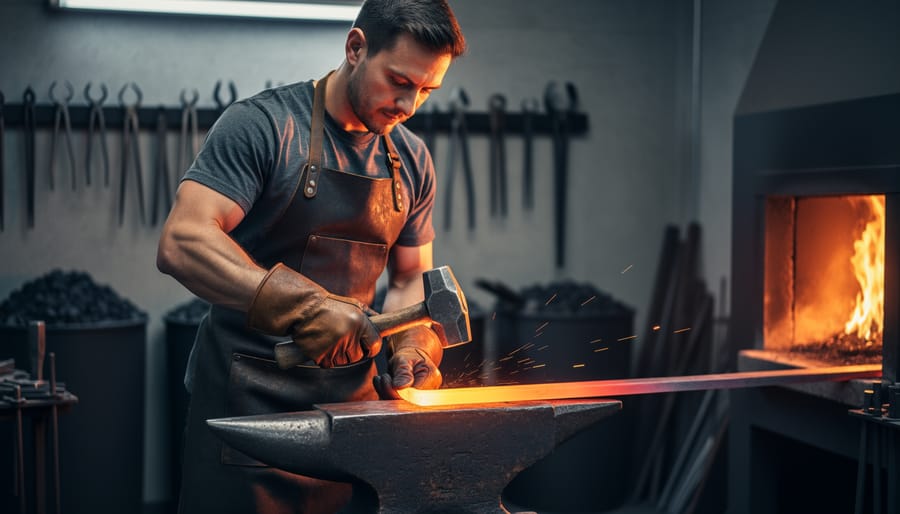
A quality blacksmithing course combines hands-on forge time, experienced instruction, and progressive skill-building that takes complete beginners from their first hammer strike to creating functional metalwork in just a few sessions. The right course for you depends on three core factors: whether you want in-person or online instruction, your available time commitment (weekend intensives versus weekly classes), and your budget range, which typically spans from $150 for single-day workshops to $2,000+ for comprehensive multi-week programs.
Most people searching for blacksmithing courses feel drawn to the craft but worry they lack the strength, prior metalworking experience, or access to expensive equipment. Here’s the encouraging reality: modern blacksmithing education has evolved to welcome anyone with curiosity and willingness to learn. Studios across the country now offer beginner-friendly environments where you’ll work with properly-sized tools, learn efficient techniques that rely more on precision than brute force, and discover that the barrier to entry is far lower than you imagined.
The blacksmithing community thrives on shared knowledge and mentorship. Similar to how many crafters start woodworking basics through guided instruction, your first course connects you with experienced smiths who remember their own early struggles and genuinely want to see you succeed. You’ll find that metalworking skills develop through practice and patience rather than innate talent.
This guide walks you through the selection criteria that separate exceptional courses from disappointing ones, compares the main course formats available in 2026, and provides specific recommendations matched to different learning styles and goals.
What to Look for in a Quality Blacksmithing Course
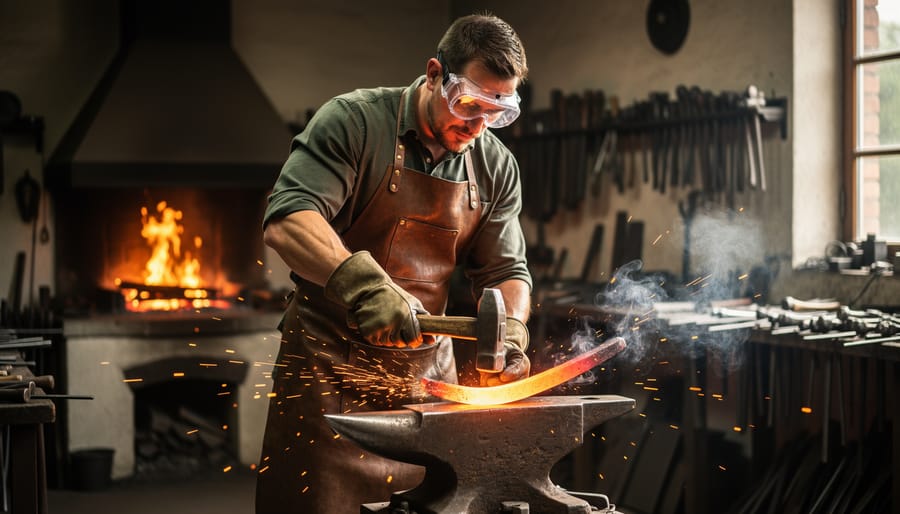
A blacksmithing course is only as good as what you actually learn and retain, and several concrete factors separate transformative hands-on education from disappointing experiences that leave you with more questions than skills.
Start with the instructor. Check their background beyond a simple bio: How many years have they been forging? Do they work as professional smiths, or is teaching their primary focus? Both can be valuable, but you want someone who actively practices the craft and understands contemporary techniques alongside traditional methods. Look for instructors who share their own work publicly, participate in the smithing community, and can articulate not just the “how” but the “why” behind each technique. A seasoned smith who’s made thousands of projects will troubleshoot your struggles differently than someone who primarily teaches from a curriculum.
Next, scrutinize the hands-on ratio. The benefits of hands-on learning in physical crafts like blacksmithing can’t be replicated through observation alone. Quality courses dedicate at least 70 percent of class time to you working at the forge, with demonstrations brief and targeted. Ask prospective programs how much individual forge time each student receives. If you’re watching the instructor for three hours and hammering for thirty minutes, you’re paying to be an audience member, not a student.
Class size matters more than many beginners realize. A ratio of six students per instructor allows meaningful feedback on your hammer technique, heat control, and problem-solving. Beyond eight students per forge station, individual attention drops sharply. You’ll spend more time waiting for guidance and less time correcting mistakes while they still matter.
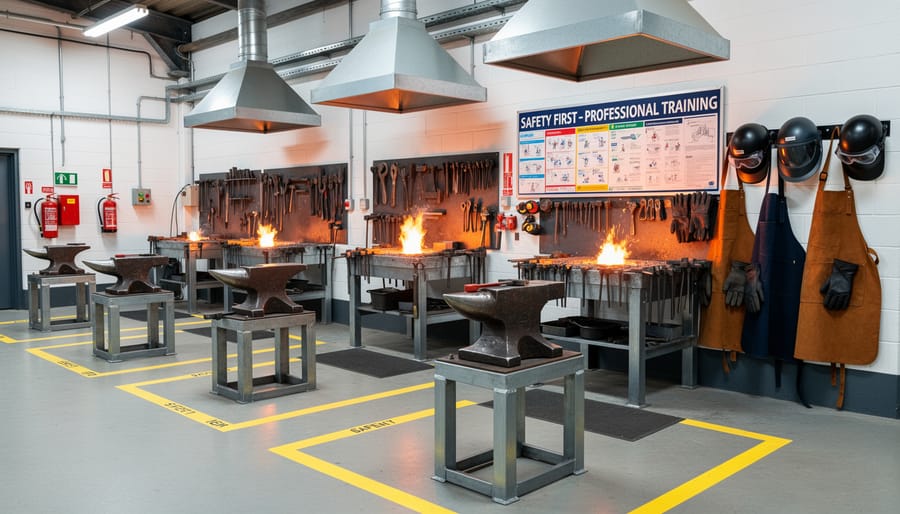
Equipment quality tells you whether the program respects the craft. Well-maintained anvils, properly functioning forges with consistent heat, adequate ventilation, and a range of hammer weights and tong styles indicate a serious operation. Touring the facility before enrolling isn’t excessive, it’s smart. Rusty tools and makeshift setups compromise both safety and learning.
Safety training should begin before you touch a hammer. Comprehensive programs cover eye protection, proper clothing, fire protocols, handling hot metal, ventilation awareness, and emergency procedures. This isn’t a five-minute overview; expect at least thirty minutes dedicated to safety in any legitimate introductory course.
Finally, understand what’s included in your tuition. Some courses provide all materials, steel stock, coal or propane, even safety glasses. Others charge separately for consumables or expect you to bring your own leather apron and tools. Calculate the true cost before comparing programs. A seemingly expensive course that includes twenty pounds of practice steel and lets you keep your finished pieces may cost less overall than a cheap workshop with hidden material fees.
Post-course support separates community-focused programs from transactional ones. Do graduates have access to open forge times? Is there a mentorship structure or online forum for questions? The best courses don’t end when class does, they welcome you into a broader network of smiths who’ll help you grow long after you’ve paid your tuition.
Types of Blacksmithing Courses Compared
Introductory Workshops vs. Multi-Week Courses
Single-day and weekend workshops offer the perfect low-commitment entry point if you’re curious about blacksmithing but unsure whether you’ll love standing at a forge. These introductory experiences typically run four to eight hours, giving you enough time to heat metal, practice basic hammer techniques, and complete a simple project like a hook, bottle opener, or fire poker. You’ll get a genuine feel for the rhythm of forging without investing weeks of your schedule or significant money. Many beginners succeed faster in workshops because the concentrated format keeps you focused and instructors can address questions immediately.
Multi-week courses, usually spanning four to twelve sessions over several weeks or months, are designed for serious skill development. You’ll progress beyond single projects to master fundamental techniques: drawing out, upsetting, bending, twisting, and forge welding. The spacing between sessions gives you time to absorb concepts, practice if you have access to a forge, and return with questions. These courses build muscle memory and confidence through repetition that a single weekend can’t provide. The trade-off? Greater time commitment, higher cost (typically three to five times a workshop fee), and the need to maintain consistency. Choose workshops to explore; choose multi-week programs to genuinely develop as a smith.
In-Person vs. Online Blacksmithing Instruction
In-person blacksmithing courses offer the irreplaceable value of feeling heat on your face, hearing metal respond to your hammer, and receiving immediate corrections to your grip or stance. The sensory feedback from working a live forge builds muscle memory and intuition that’s difficult to replicate remotely. You’ll also benefit from spontaneous demonstrations when your instructor spots a common mistake and shows the entire class the fix in real time.
Online courses, however, remove geographical and scheduling barriers entirely. If you live hours from the nearest forge or work irregular shifts, quality video instruction lets you master essential techniques through detailed close-ups and slow-motion footage that reveal hand positioning and timing better than watching from across a crowded workshop. Research on online and blended learning effectiveness shows that well-designed remote courses can deliver strong educational outcomes when students have access to basic equipment.
Hybrid models increasingly split the difference: online modules cover theory, tool identification, and project planning, while periodic in-person intensives provide supervised forge time. This approach suits serious learners balancing practical skill development with the realities of distance and cost, giving you structured knowledge building at home and critical hands-on correction when it matters most.
General Forging vs. Specialized Techniques
Foundational blacksmithing courses teach core techniques applicable across all metalwork: controlling fire and heat, reading metal color, drawing out (lengthening), upsetting (thickening), bending, twisting, and punching. These general forging classes build the muscle memory and judgment that underpin everything else. You’ll typically make simple projects like hooks, bottle openers, or basic tools, items that reinforce fundamentals without overwhelming you with complexity.
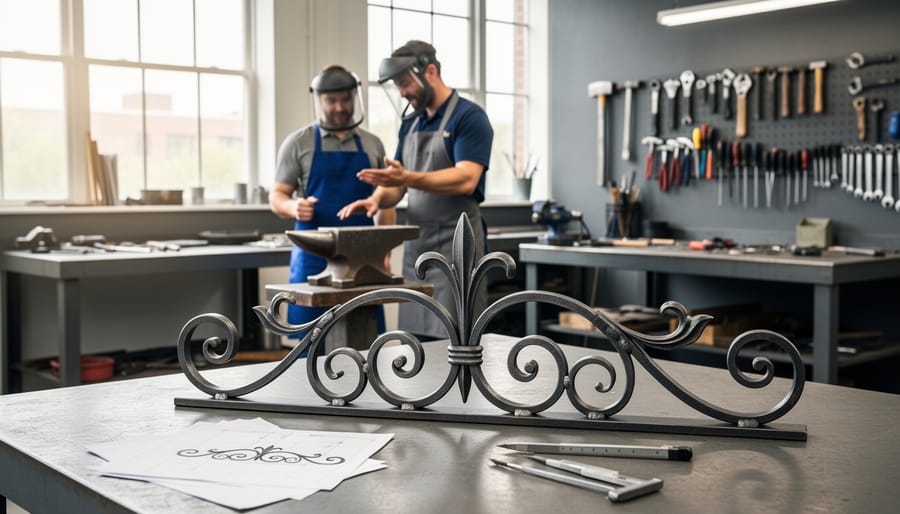
Once you’ve got the basics down, specialized courses let you dive deep into specific applications. Knife-making classes focus on blade geometry, heat treatment, differential hardening, and handle fitting. Tool forging emphasizes durability and function, teaching you to make hammers, tongs, chisels, and other forge equipment. Decorative ironwork courses concentrate on scrollwork, repousse (raised designs), texture techniques, and architectural elements like gates or railings. Bladesmithing programs, sometimes overlapping with knife-making, often include pattern welding (Damascus steel), fuller work, and traditional weapon forms.
Starting with general forging makes sense for most beginners; it gives you the vocabulary and confidence to recognize what specialization excites you. Jumping straight into a specialized class without foundational skills usually means struggling with basic hammer control when you should be learning the nuances that make great knives or elegant scrolls.
Certificate Programs and Professional Training
For smiths committed to turning their passion into a profession, certificate programs and apprenticeships offer structured pathways to mastery. These comprehensive programs typically run from six months to two years and deliver both technical excellence and recognized credentials that carry weight in the craft community.
Traditional apprenticeships remain the gold standard, working alongside a master blacksmith while learning the trade’s full scope, from forge management to business practices. Organizations like the Artist-Blacksmith’s Association of North America (ABANA) maintain directories of accredited master smiths accepting apprentices. These positions are competitive but provide unmatched hands-on experience and direct mentorship.
Certificate programs through craft schools and technical colleges offer more structured alternatives. They combine intensive forge time with coursework in metallurgy, design, tool maintenance, and workshop safety. Many include business development modules covering pricing, marketing, and running a forge-based enterprise.
The investment is substantial, programs range from $5,000 to $25,000 depending on duration and institution, but graduates leave with a comprehensive skill set, a professional portfolio, and credentials that open doors to teaching positions, commissioned work, and gallery representation. Several programs also facilitate job placements within the metalworking industry or help establish independent forges.
Top Blacksmithing Course Recommendations for 2026
Best for Complete Beginners
The Crucible’s “Intro to Blacksmithing” weekend workshop consistently ranks among the best entry points for complete novices. Over two days, students forge their first hook, bottle opener, and small knife under close supervision, with class sizes capped at six to ensure personalized feedback. Instructor Sarah Martinez, a twenty-year smith and certified safety trainer, spends the opening hour on proper hammer grip, stance, and fire management before anyone touches hot steel. The studio provides all tools, materials, and protective gear, removing the intimidation factor many beginners face. What sets this program apart is its structured progression: day one covers basic drawing and tapering techniques, while day two introduces bending and punch work, giving you a solid foundation without overwhelming you. Students leave with finished pieces, clear safety habits, and a course buying guide outlining next steps in your metalworking journey. Alumni consistently praise the patient teaching style and the confidence boost from completing real projects on your first weekend at the forge.
Best for Intermediate Smiths Advancing Skills
For smiths comfortable with basic forging who want to push beyond simple hooks and fire pokers, look for courses that dive into specialized techniques rather than rehashing fundamentals. The best intermediate programs structure projects around skills like forge welding, damascus pattern creation, or controlled tapering for blade work, teaching you the “why” behind heat management and hammer control at a deeper level.
Class size matters even more at this stage. You’ll benefit most from programs capping enrollment at six to eight students, giving instructors time to critique your technique and troubleshoot issues specific to complex joinery or differential hardening. Weekend intensives focused on single challenging projects, a chef’s knife, decorative gate hardware, or traditional toolmaking, often deliver more progress than broader multi-week courses that split time across too many topics.
Strong intermediate courses connect you with working blacksmiths who can discuss real-world problem-solving: dealing with difficult steels, refining your finishing process, or setting up an efficient home forge. Programs offering open forge time alongside instruction let you practice new techniques immediately while mentors are available to answer questions.
Best Online Blacksmithing Courses
Online blacksmithing courses have evolved significantly, offering genuine learning value through detailed demonstration videos, slow-motion technique breakdowns, and instructor feedback on submitted project photos. The best remote programs can’t replace forge time, but they excel at teaching design principles, understanding metallurgy, and demonstrating proper form before you commit to expensive in-person training.
Look for courses featuring multiple camera angles during forging demonstrations, active student forums where experienced smiths answer questions, and structured project assignments with personalized critique. Programs like those offered through Alec Steele’s online platform or Purdue University’s distance learning blacksmithing modules provide professional-grade instruction accessible from anywhere. Many successful online students use these courses to build theoretical knowledge while practicing basics at local makerspaces or rented forge time, creating a hybrid learning approach that fits varied schedules and budgets.
Best Value Workshop Experiences
You don’t need deep pockets to start forging. Community college blacksmithing workshops often run $75-150 for a full day, including materials and safety gear. Look for programs run through local arts centers or historical societies, they’re typically subsidized and focus on education over profit. The Appalachian Center for Craft and similar regional schools offer weekend intensives around $200 that pack serious skill-building into condensed sessions. Watch for guild-sponsored events where experienced smiths volunteer their time; you’ll get expert instruction at barely-above-cost pricing. Value isn’t about cheap, it’s about getting quality teaching, proper supervision, and enough forge time to actually make something you’re proud of without the premium markup.
Common Mistakes to Avoid When Choosing a Blacksmithing Course

Choosing your first blacksmithing course feels exciting, but rushing into the decision often leads to frustration and wasted money. Many newcomers make easily avoidable mistakes that can sour their introduction to metalworking before they’ve even struck their first blow on the anvil.
The most common error is selecting a course based solely on price. While budget matters, the cheapest option frequently cuts corners on forge time, materials, or instructor quality. You’ll spend your day watching demonstrations rather than hammering metal yourself, or working with substandard materials that behave unpredictably. A slightly more expensive course that includes quality materials, generous hands-on time, and expert guidance delivers far better value than a bargain workshop that leaves you confused and discouraged.
Just as damaging is ignoring the instructor’s background. Not everyone who works metal can teach effectively. Look for instructors with demonstrable teaching experience, not just years at the forge. Check for student testimonials, portfolio work, and whether they’ve trained other successful smiths. A master craftsperson who can’t explain techniques clearly or adapt to different learning styles won’t help you progress, no matter how skilled they are personally.
Class size deserves serious consideration too. Workshops with twenty students and one instructor mean minimal individual attention when you’re struggling with hammer control or fire management. Ideal ratios range from four to eight students per instructor, ensuring you get personalized feedback and corrections before bad habits set in.
Many students overlook what’s actually included in the course fee. Does it cover materials, or will you pay extra for every piece of stock you forge? Are tools provided, or must you bring your own? What about safety equipment? Hidden costs add up quickly and turn an affordable course into an expensive surprise.
Finally, don’t dismiss the learning community and post-course support. The best courses connect you with fellow students and provide resources for continued learning after the final session. Blacksmithing improves through practice and peer feedback, so courses offering online forums, practice sessions, or alumni groups help you maintain momentum long after you’ve left the workshop.
Making the Most of Your Blacksmithing Course Investment
You’ve invested time and money in a blacksmithing course, now squeeze every ounce of value from it. Before your first session, write down specific questions about techniques that intrigue you or projects you’d like to tackle. Instructors appreciate prepared students and can tailor demonstrations to address real curiosities rather than generic content.
Connect with your classmates immediately. Exchange contact information on day one and form a practice group. These relationships often prove more valuable than the course itself, you’ll share discoveries, troubleshoot problems together, and maintain motivation when solo practice gets frustrating. Many lifelong blacksmithing partnerships start in beginner workshops.
Practice between sessions, even if it’s just fifteen minutes reviewing your notes or sketching design ideas. Muscle memory fades quickly; the student who hammers twice a week will progress faster than one who waits for monthly classes. If you don’t have forge access, study videos of professional smiths working, analyze their hammer rhythm and body positioning.
Document everything. Photograph your pieces from multiple angles, noting what worked and what didn’t. Keep a simple notebook tracking techniques learned, heat colors observed, and mistakes made. This record becomes invaluable when you revisit challenging concepts months later.
Join online blacksmithing forums and local guild meetings during your course. The broader community offers perspective beyond your instructor’s methods, you’ll discover different approaches to the same problem and learn about advanced techniques like what epoxy resin is for finishing handles or protective coatings.
Plan your next step before graduating. Whether that’s purchasing starter equipment, enrolling in an intermediate course, or apprenticing with a local smith, momentum matters. Students who immediately apply their new skills retain far more than those who pause for months.
Frequently Asked Questions About Blacksmithing Courses
One of the most reassuring aspects of the blacksmithing community is how welcoming it is to curious newcomers. The questions below come up repeatedly from aspiring smiths exploring their first course, and understanding the answers helps you approach your learning journey with realistic expectations and proper preparation.
Do I need any prior experience or skills to start a blacksmithing course?
Most introductory courses welcome complete beginners with zero metalworking background. You’ll learn everything from lighting the forge to holding the hammer correctly, though basic physical coordination and a willingness to follow safety protocols are essential.
What are the physical requirements for blacksmithing?
You need moderate upper body strength and the ability to stand for extended periods, typically two to four hours. Many smiths adapt their techniques to work within their physical capabilities, and good instruction emphasizes proper body mechanics over brute force.
Do I need to buy my own tools and equipment before starting?
Reputable beginner courses provide all necessary tools, safety gear, and materials as part of the tuition. Investing in personal equipment makes sense only after you’ve developed foundational skills and confirmed your commitment to the craft.
How much do blacksmithing courses typically cost?
Single-day workshops range from $150 to $400, while comprehensive multi-week courses run $800 to $2,500 depending on duration and materials included. Certificate programs can reach $5,000 or more but often include extensive forge time and professional mentorship.
How much time should I commit to learning blacksmithing?
A weekend workshop offers a meaningful introduction, but developing genuine competence requires at least 40 to 60 hours of forge time spread across several months. Most hobbyists progress well with one or two sessions monthly plus independent practice.
Is blacksmithing dangerous, and how are safety concerns addressed?
Working with fire and hot metal carries inherent risks, but proper instruction dramatically reduces danger. Quality courses dedicate substantial time to safety protocols, protective equipment use, and hazard awareness before students touch the forge.
Can I turn blacksmithing skills into a career or business?
Many smiths successfully sell custom knives, tools, architectural metalwork, and decorative pieces, though building a full-time income typically requires years of skill development, business acumen, and market cultivation. Most professionals recommend starting as a passionate side pursuit before transitioning to commercial work.
These practical considerations matter because blacksmithing demands real commitment, but the barriers to entry remain refreshingly low compared to many traditional crafts. You don’t need expensive home equipment, years of study, or exceptional physical strength to start forging meaningful projects and connecting with a supportive creative community.
Choosing the right blacksmithing course isn’t about finding the most expensive program or the nearest workshop. It’s about matching your goals, learning style, and time commitment with an instructor and format that genuinely supports your growth. Whether you’re testing the waters with a weekend introduction or diving into a multi-week intensive, the best course is one that leaves you confident at the forge and eager to keep hammering.
The blacksmithing community welcomes newcomers with open arms, and the right course becomes your gateway into a network of makers who share techniques, troubleshoot challenges, and celebrate each other’s progress. You’re not just learning to shape metal, you’re joining a tradition that values craftsmanship, creativity, and continuous improvement.
Bush Furniture Worldwide Online Courses connects aspiring smiths with experienced instructors who understand that every student brings unique goals and abilities to the anvil. Our curated programs emphasize hands-on learning, safety fundamentals, and ongoing community support, ensuring you build both technical skill and creative confidence. Your metalworking journey starts with a single hammer strike, and the right course makes every blow count.